


UN4UkrainianCities Contributes to Seminar on Wartime Reconstruction at Politecnico di Milano, Italy
© Politecnico di Milano
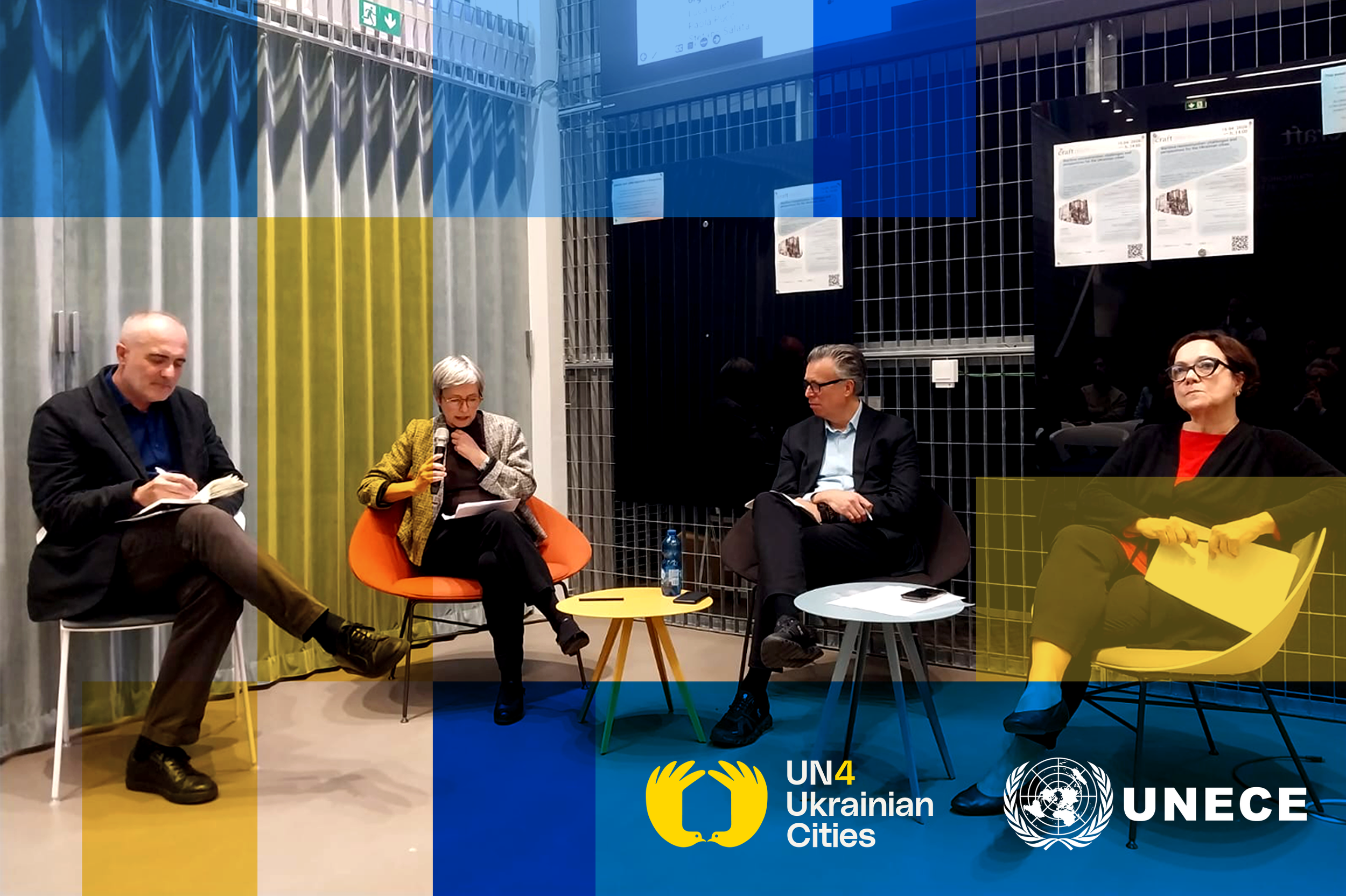
On 15 April, Politecnico di Milano convened a seminar titled “Wartime Reconstruction: Challenges and Perspectives for Ukrainian Cities,” bringing together academics, architects, and urban practitioners to reflect on the evolving realities of rebuilding in Ukraine. The discussion built on the interdisciplinary collaboration captured in the book Planning in Wartime: A Blueprint for the Mykolaiv Masterplan, offering a platform to bridge theory and practice, and to examine how planning tools, design approaches, and institutional frameworks can respond to the urgency, complexity, and long-term vision required for recovery in times of conflict.
The UNECE initiative UN4UkrainianCities represented by Mr. Dario Liguti, Director of the Energy, Housing and Land Management Division, contributed insights on how integrated policy frameworks, technical assistance, and pilot projects are supporting Ukrainian cities in navigating reconstruction while embedding long-term resilience and sustainability.
Reconstruction in Ukraine: Between Uncertainty and Long-Term Planning
The core topic of the seminar was wartime reconstruction in Ukrainian cities, with a particular focus on the case of Mykolaiv and the collaboration between academics and professionals in developing its concept masterplan. While acknowledging uncertainty in rebuilding, initially grounded in the expectation of stability and peace, the seminar noted that initiatives such as UN4UkrainianCities aim to facilitate practical, adaptive urban recovery by connecting high-level planning with realities on the ground. This initiative was launched to offer tailored support and propose flexible, long-term visions for urban development.
Building on these reflections, Mr. Dario Liguti underscored that the true test of any recovery effort lies in its ability to move from planning to execution. Masterplans, while essential, must evolve into a structured pipeline of deliverable and investment-ready projects, grounded in reality and capable of being implemented step by step. This shift requires not only technical rigor, but also a rethinking of how projects are designed, financed, and delivered in today’s context.
He highlighted that this transition is unfolding in a profoundly altered global landscape. Compared to just a few years ago, the environment is now shaped by overlapping crises, geopolitical tensions, and shrinking financial resources. Donor priorities are shifting, public funding is under pressure, and competition for attention and investment has intensified. In this setting, traditional models of international cooperation are no longer sufficient on their own.
Against this backdrop, he stressed the importance of protecting and adapting multilateralism, recognizing it as a public good that remains essential for coordinated and inclusive recovery efforts. However, adaptation is key. Rather than relying on rigid frameworks, recovery approaches must become more flexible, modular, and iterative, able to adjust to changing conditions while maintaining strategic direction.
This implies a move towards phased implementation, where projects are broken down into achievable steps that can deliver early results. Such an approach not only mitigates risk but also creates opportunities to demonstrate impact quickly. This way, projects will help build confidence, attract additional resources, and generate momentum for scaling up interventions.
Ultimately, he emphasized that beyond funding and technical capacity, trust is the defining factor. In a context where trust is often fragile, delivering transparent, inclusive, and tangible results become the foundation for sustained engagement. Rebuilding cities, therefore, is not only about infrastructure, but also about restoring confidence in institutions, processes, and the collective vision for the future.
From Policy to Practice: Shaping Ukraine’s Housing and Urban Future
Expanding on the policy dimension of recovery, Mr. Dario Liguti highlighted a major milestone: the recent adoption of a national law “On the Fundamental Principles of the Housing Policy” in Ukraine, supported through the work of the UNECE UN4UkrainianCities project. While this represents a critical step forward, passing legislation is only the beginning, the real challenge now lies in translating this framework into actionable regulatory mechanisms. It is at this stage, where implementation details are defined, that key questions emerge around housing affordability, social housing models, construction standards, and delivery systems.
Beyond housing, he stressed the importance of advancing a broader integrated urban development approach, working closely with Ukrainian authorities across sectors such as energy, transport, environment, and public infrastructure. A persistent challenge in many countries is the fragmentation of planning processes, where ministries operate in silos, leading to inefficiencies and missed opportunities. For instance, ambitions to electrify urban transport cannot be realized without corresponding investments in energy capacity and infrastructure. Addressing these gaps requires coordinated, cross-sectoral planning that aligns national priorities with local implementation.
He also pointed to two defining drivers shaping Ukraine’s recovery strategy. The first is security and resilience, reflected in the need to design infrastructure systems that are less vulnerable and capable of functioning under stress, particularly in sectors such as energy, where redundancy and decentralization become essential. The second is Ukraine’s clear ambition to align itself with international standards and systems, through its infrastructure, governance models, and development pathways.
This leads to a broader and more complex question: the balance between centralization and decentralization. Ukraine, historically more centralized, is now navigating how to structure governance and infrastructure systems in a way that enhances resilience while maintaining coherence and national direction. As highlighted, more decentralized systems have, in many contexts, demonstrated greater capacity to adapt and recover from shocks. However, finding the right balance is ultimately a political and societal choice, one that will shape how decisions are made, how resources are allocated, and how cities evolve.
In this context, UNECE’s role extends beyond technical assistance. It is about supporting Ukraine’s cities in defining their long-term vision, drawing on international experience, showcasing different governance models, and helping translate strategic choices into concrete sectoral decisions, from housing to mobility and energy. These choices will not only influence the effectiveness of reconstruction efforts but will also determine how Ukrainian cities position themselves in the future, once stability is restored.
Action for Hope: Key Takeaways from the Discussion
In his closing remarks, Mr. Liguti conceded that swift implementation may risk missteps but contended the potential is invaluable:
“Maybe in rushing into implementation, we could make mistakes. But for me, the hope it gives to the population and to those who are outside and may return, seeing that things can happen and are happening in the best possible way, according to local conditions, transparently and honestly, is priceless.”
The seminar showed that reconstruction in Ukraine must navigate uncertainty. Flexible, adaptive approaches are necessary. Bridging the gap between planning and action is essential. Concrete results can rebuild trust and engage local communities. A key strength of UN4UkrainianCities is its ability to combine international cooperation with local involvement and strategic planning. These efforts are transformed into tangible, resilient, and forward-looking urban recovery paths.